
Executive summary
Revecore helps hospitals recover revenue tied up in denied, underpaid, and complex claims.2 Its nurses spend hours reviewing medical records and preparing appeals. Awaken designed and built EMR Extracts, an AI platform that finds relevant clinical evidence and prepares appeal drafts for nurses to review.
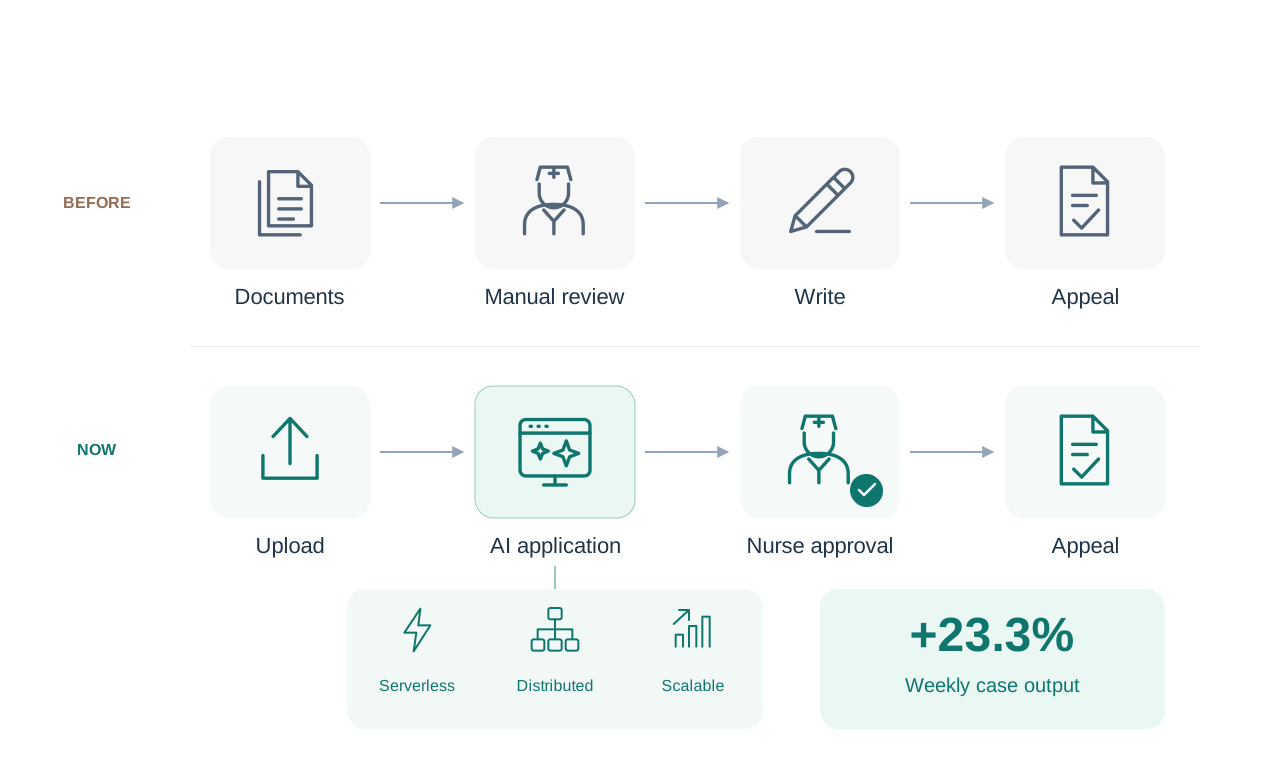
With the platform in use, weekly case output across the full medical-necessity nurse team increased by 23.3%, and nurses used 100% of generated letters as a starting point for their appeals. Over 12 months, we took the project from an initial concept to a production system that Revecore could extend to other claims workflows.1
The situation
Revecore identifies claims with recovery potential, then prepares the records for specialist review. Nurses assess whether the treatment was medically necessary and build the clinical case for challenging a denial. Their capacity directly affects how many recovery opportunities the business can pursue.
Nurses review medical records, claim forms, and payment explanations to prepare appeals for insurers. Every clinical assertion needs supporting evidence that the reviewer can trace back to the original record.1
The challenge
Revecore’s process could identify roughly two million candidate claims, but only about 30,000 reached the nurse team for deeper review each year. Preparing a case took approximately two to three hours, with clinical review and appeal writing requiring another two to three hours. Specialist capacity was a constraint on the number of cases the team could handle.1
The records had a median length of approximately 268 pages during the engagement, and some exceeded 10,000 pages. Nurses needed to find the relevant evidence in those records and verify it.1
Unsupported reasoning, missed evidence, or incorrect citations could weaken an appeal and put the recovery opportunity at risk. Because the records contain protected health information, the system also had to keep its work inside Revecore’s controlled environment and preserve an auditable record of how each output was produced.1
What we did
Awaken built EMR Extracts to turn lengthy case records into a clinical summary, an explanation of the appeal’s reasoning, and a draft letter with source citations. We designed the platform to support additional claims workflows, starting with medical-necessity appeals.
-
Prepare
Prepared case
Staff organize the medical record, claim forms, and supporting documents for review.
-
Assist
EMR Extracts
Awaken’s platform finds relevant evidence and prepares a summary and appeal draft with source citations.
-
Approve
Nurse-reviewed appeal
A nurse checks the cited evidence, edits the draft where needed, and remains responsible for every appeal.
Nurses can follow each citation to its source and edit the draft, reducing the need to repeat the initial search through the record.
We built the application to operate inside Revecore’s approved environment, with controlled access, data-retention safeguards, and traceability for audit review. That gives legal, compliance, and IT stakeholders the controls they need without exposing protected health information outside the company’s environment.1
How we worked
We were Revecore’s AI delivery team and worked directly with operations, the director of nurses, frontline nurses, IT, legal, and compliance. To understand the workflow, we shadowed nurses working cases, interviewed stakeholders, reviewed completed appeals, and mapped the process from prepared record to final letter. We met with the director of nurses at least twice a week and collaborated over messaging nearly every day.1
Nurses helped us focus on the work that would save them the most effort: summarizing large records and finding supporting evidence.
In the first two months, we turned the business idea into a working proof of concept. Over the following two months, we delivered an initial application that operated within Revecore’s security constraints and supported the medical-necessity workflow. We spent the remaining eight months improving the production system: observing how nurses used the drafts, identifying where significant rework was still required, and improving the summaries and drafts around that feedback.1
Before each production release, we tested the workflow with the director and nurses. Surveys and usage data then showed where drafts were helping and where the system still created friction. We used that evidence to guide each round of production improvements.
We trained the nurse team and kept the interface simple, with guidance inside the application so nurses could learn the workflow with minimal formal training.
Results
- Weekly nurse case output increased by 23.3% across the full medical-necessity nurse team compared with the previous year’s weekly average.
- Nurses used 100% of letters generated in production as a starting point for completing the appeal, reviewing and editing each draft as needed.
- Every generated appeal remained subject to nurse review, with source citations designed to make verification faster.
Results reflect client-provided production data and in-product usage measurements.1
What changed for the business
Awaken gave Revecore greater capacity in a workflow that supports revenue recovery. Nurses now start with a structured summary and an evidence-backed draft, leaving more time to apply their clinical judgment to additional cases.
Revecore retains approximately 30% of the value it recovers. At that rate, an additional $1 million recovered for hospital clients would represent roughly $300,000 in Revecore revenue. This is an illustration of potential revenue, not a measured financial result of the engagement.1
The results also gave Revecore’s leadership the evidence to fund an internal AI team. What began as a conservatively funded proof of concept became a production capability with a dedicated team to build on Awaken’s work. Revecore’s annual investment in that team is estimated to be well above $1 million and potentially near $2 million.1
What Revecore leaders said
At a company-wide town hall, Revecore’s CEO praised EMR Extracts and presented it as one of the company’s core offerings. The operations team also reported that it had evaluated vendors claiming to provide similar capabilities and considered the product Awaken built superior for Revecore’s medical-necessity workflow.1
“What you've built is awesome! The nurses love it; it's making everyone's lives easier. The whole company wants to get their hands on this!”
 Brian Niederhauser
COO, Revecore
Next steps
The platform Awaken delivered gives Revecore’s internal AI team a foundation for supporting additional appeal categories and departments. Each new workflow will need its own testing and quality checks. Leadership is also exploring whether the capability could become a client-facing product.
Sources and methodology
- Awaken engagement records and client-provided production data, 2025. Source for workflow volumes and timing, document-length observations, production measurements, security controls, commercial assumptions, project timeline, investment estimates, and leadership feedback. These records are internal and not publicly available; estimates and illustrative calculations are labeled in the text.
- Revecore, company website. Source for the company's service description, 1,300+ hospital clients, and $2.5B+ in annual cash collections.
- Revecore on LinkedIn. Source for the 1,001–5,000 employee company-size band.
- LeadIQ company profile for Revecore. Source for the third-party estimated annual revenue range of $250M–$500M. This is not an audited company disclosure.
Public sources accessed September 2026. Third-party estimates are identified as such and should not be read as audited Revecore disclosures.
What could we build for you?
Tell us about your project. Let’s talk through what it would take.
Let’s talk